
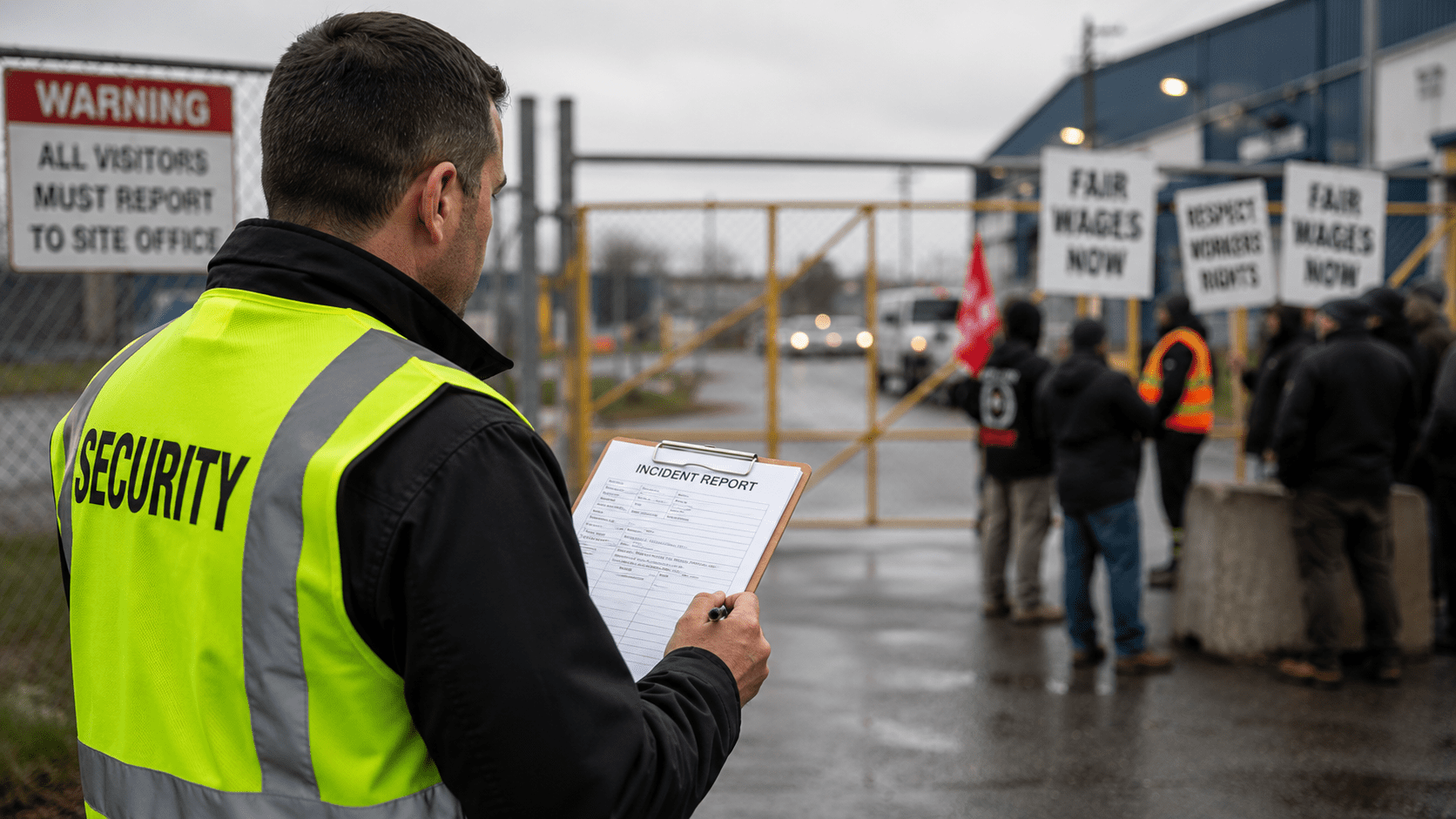
Labour dispute evidence can determine whether an employer has a defensible response or only a collection of claims after the fact. When a labour dispute becomes active, attention often turns to the visible conflict: picket lines, access points, vehicle movement, employee crossings, replacement worker logistics and operational disruption. But behind the scenes, one factor can shape the entire response: evidence.
In a Canadian labour dispute, employers need more than observations or verbal reports. They need clear, organized and properly preserved evidence that shows what happened, when it happened, where it happened, who was involved and how the incident affected operations.
Evidence gathering can support three major areas: injunctive relief, criminal charges and civil action. It can also help labour counsel, site leadership, police and the courts understand the facts of a fast-moving situation.
Without proper evidence, an employer may know that serious incidents occurred, but knowing something happened is not the same as being able to prove it.

Labour Dispute Evidence Supports Injunctive Relief
One of the most important reasons to collect evidence during a labour dispute is to support potential injunctive relief.
During strike action, lockouts or picketing, the movement of people, vehicles and products in and out of a site often becomes the pressure point. Delays at access gates, blocked entrances, unsafe conduct, intimidation, threats, property damage or obstruction can affect whether an employer can continue operating safely.
Evidence collected at the picket line may help show what happened, where it happened, who was involved, how often it occurred and how the conduct affected site access or operations.
In British Columbia, the Labour Relations Board states that it has exclusive jurisdiction to decide whether a strike, lockout or picketing is lawful, and it can decide whether the location and timing of picketing are lawful. The Board also notes that conduct on a picket line, where picketing is otherwise lawful under the Code, may fall within the jurisdiction of the courts.
Source: BC Labour Relations Board
That distinction matters. Labour disputes can involve both labour board issues and court-related issues. If an employer seeks an injunction, vague statements such as “the picket line was aggressive” may not be enough. Specific incidents should be documented with dates, times, locations, footage, photos, witness notes and incident reports.
In some situations, an employer may also need an enforcement order so local law enforcement can enforce the injunction. That process depends heavily on documentation.
Labour Dispute Evidence Can Support Criminal Charges
Most labour disputes do not involve criminal conduct. Many picket lines remain lawful and peaceful. But when a dispute becomes contentious, employers need to prepare for the possibility of threats, assault, mischief, property damage, vehicle interference, harassment or other conduct that may require police involvement.
If criminal activity takes place on a picket line, law enforcement will need evidence. That evidence may include video footage, still photographs, drone footage, written notes, incident reports, witness statements or other documentation showing what occurred.
The goal is not to exaggerate the situation. The goal is to preserve an accurate record so police and legal counsel can review facts instead of relying on memory.
Evidence quality matters. A blurry video that does not show the incident clearly may have limited value. A photo that does not identify the person, location or context may not help. A written note prepared days later may carry less weight than a time-stamped report created shortly after the incident.
The Canada Evidence Act recognizes that records made in the usual and ordinary course of business can be admissible in legal proceedings, subject to the requirements of the Act and the court’s assessment. It also defines “record” broadly to include information that is written, recorded, stored or reproduced.
Source: Canada Evidence Act, Section 30
For employers, this reinforces the importance of disciplined reporting. Records created through a consistent process may become far more useful later than informal notes, screenshots or scattered files.
Evidence Can Support Civil Action
Evidence can also support civil action during or after a serious labour dispute.
An employer may consider civil action if a dispute involved property damage, business interruption, trespass, intimidation, unlawful obstruction or other serious incidents. Whether that step makes sense will depend on the facts, legal advice and the specific circumstances.
Civil action often depends on the ability to establish what happened and connect that conduct to specific loss or damage. That may require video, photographs, witness statements, incident reports, access logs, vehicle logs, drone footage, repair invoices, timelines and written records.
Still photos, video footage and written reports may also form part of an affidavit prepared with labour counsel. In that situation, the person providing the affidavit may need to sign off on the evidence. That makes accuracy and continuity extremely important.
Quality of Evidence Matters
Evidence collection depends on three major components: quality, continuity and type.
The first is quality.
High-quality evidence should answer practical questions clearly: what happened, who was involved, where the incident occurred, whether the footage captures the full sequence or only the aftermath, and whether the time stamp matches the incident report.
At a labour dispute, poor-quality evidence can create confusion. A camera placed too far from the gate may miss key details. A phone video filmed from the wrong angle may fail to show who initiated the incident. A still photo may show damage but not when or how the damage occurred.
Strong evidence collection requires planning before the dispute begins. The employer should know which access points matter, where cameras should be positioned, who can record incidents, who will write reports and how files will be stored.
Continuity of Evidence Matters
The second component is continuity of evidence.
Continuity refers to the documented chain showing who collected the evidence, when they collected it, who they passed it to and how they preserved it. That chain matters because evidence can face challenges later.
For example, if one person records video at a picket line, the employer should document who recorded it, the time and date, the location, the device used, where the original file was stored, who received a copy and whether anyone edited or compressed the file.
If the video then goes to a supervisor, that transfer should be documented. If the supervisor provides it to labour counsel, the record should show that step as well.
The Canada Evidence Act includes specific rules around records and copies, including circumstances where a copy may require supporting documents that address authenticity and source.
Source: Canada Evidence Act, Section 30
That is why employers should avoid casual evidence handling. Downloading videos to personal phones, forwarding clips through text messages, renaming files without a system or editing footage without preserving the original can create problems later.
The Type of Evidence Matters
The third component is the type of evidence collected.
During a labour dispute, useful evidence may include drone footage, video footage, still photographs, written notes, incident reports, witness statements and affidavits.
Each type serves a different purpose. Video footage may show the full sequence of an incident. Still photographs may capture damage, signs, vehicle positions or identities. Drone footage may show crowd movement, blocked access points or the wider layout of a picket line. Written notes may preserve details that a camera misses, such as verbal statements, timing, names or operational impact.
The strongest labour dispute evidence programs use multiple evidence types together. A video may show a blocked gate. A still photo may show the vehicle position. A written report may explain the delay. A witness statement may identify who was present. Together, those records tell a clearer story.
Evidence Collection Requires Planning Before the Dispute
The worst time to design an evidence process is after the picket line is already active.
Before a potential labour dispute, employers should work with legal counsel, site leadership and their security provider to define the evidence collection plan. That plan should explain who records incidents, what gets reported, how reports get written, where digital files get stored, who reviews the material, and when legal counsel or police should be notified.
The plan should also account for privacy, safety and lawful recording practices. Employers should not ask staff to escalate conflict just to capture footage. Evidence collection should support safety and documentation, not confrontation.
For sites with multiple gates, remote access roads, contractor staging areas or high-value movement points, the evidence plan should identify priority locations in advance.
Strong Labour Dispute Evidence Protects Your Options
Evidence gathering does not guarantee injunctive relief, criminal charges or civil recovery. Those decisions involve courts, police, legal counsel and the facts of each case.
But weak evidence can limit options.
If the footage is unclear, the reports are inconsistent, the chain of custody is missing or the files are scattered across personal devices, the employer may struggle to act. The incident may still have happened, but the record may not support the response.
That is why evidence collection can make or break a labour dispute response. It can determine whether an employer has a defensible record or only a collection of claims after the fact.
At Western Protection Alliance, labour dispute security is not just about presence at the picket line. It is about helping clients protect safety, continuity and documentation during a high-risk operational period. When evidence collection works properly, it gives employers, legal counsel and decision-makers a clearer view of what happened and what steps may be available next.
If your organization is preparing for a potential strike, lockout or work stoppage, evidence collection should be part of the plan before the first incident occurs. Once the dispute begins, every unclear video, missing report or undocumented file transfer can make the response harder than it needs to be.
Sources
- BC Labour Relations Board – Strikes, Lockouts, Picketing, and Replacement Workers
https://www.lrb.bc.ca/strikes-lockouts-picketing-and-replacement-workers - Canada Evidence Act, Section 30 – Business Records to Be Admitted in Evidence
https://laws-lois.justice.gc.ca/eng/acts/C-5/section-30.html - Western Protection Alliance – Mine Security: Safeguarding Operations During Labour Disputes
https://www.westernalliance.ca/mine-security/