
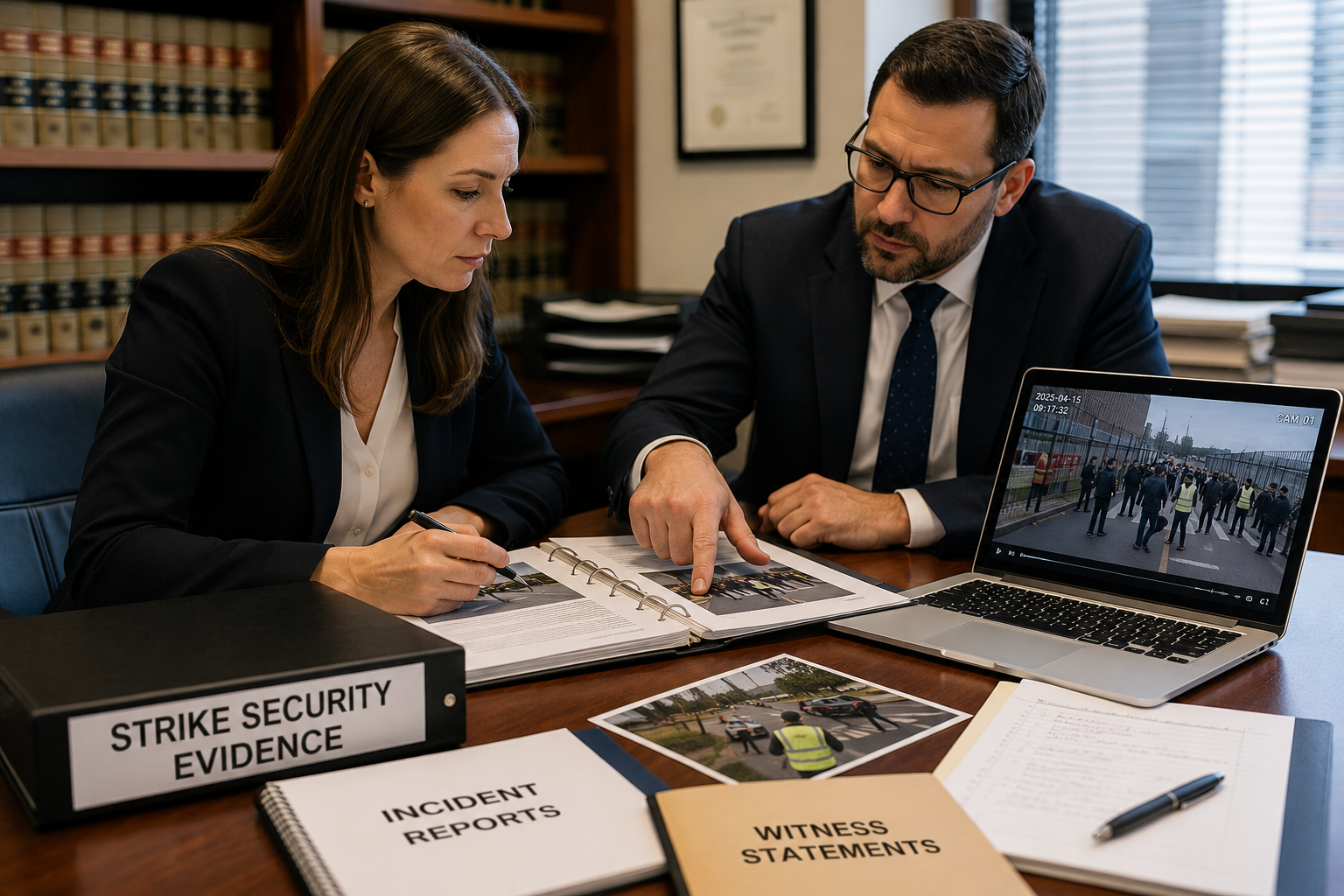
Labour lawyers need clear, organized evidence during a labour dispute. When a strike, lockout or picket line becomes active, attention often turns to visible conflict: access points, vehicle movement, employee crossings and operational disruption. But behind the scenes, one factor can shape the employer’s legal response: how well strike security collects evidence.
During a labour dispute, strike security may do more than help protect a facility. It may create the factual record that labour counsel needs to understand what happened, assess legal options and support the employer’s position.
That record can matter during picket line disputes, access issues, injunction applications, police communication, unfair labour practice allegations and internal decision-making.
For employers, the question is not only whether security is present. The question is whether the team can document facts in a way that labour lawyers can use.
Labour Lawyers Need Facts, Not Opinions
Strike security should capture facts, not opinions.
Security personnel should document what happened, where it happened, when it happened and who was involved. They should avoid assumptions, exaggeration, emotional language or commentary about what they think may happen later.
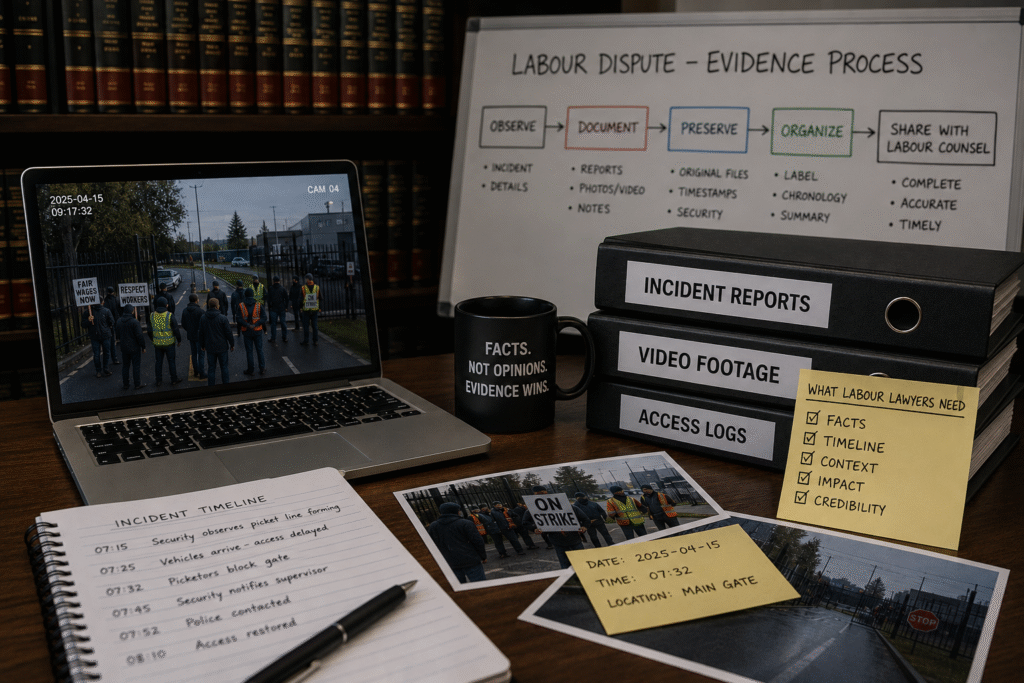
Reports should include time, date, location, weather, names, vehicles, delay times and actions taken by each party. They should also remain neutral and factual.
This matters because a report filled with commentary or unclear language can weaken the employer’s position. Labour counsel needs facts that can be reviewed, tested and connected to the dispute.
The goal is simple: document the incident, not the emotion around it.
Source: BC Labour Relations Board – Unfair Labour Practices
Labour Lawyers Need a Clear Timeline
Labour lawyers also need a clear timeline.
From the first observation to the final outcome, security should make each incident trackable. Reports should show the sequence of events, the duration of any delay, the impact on operations and the response taken by security or management.
This is especially important during picket line crossings, the first 72 hours of a labour disruption and any movement of people, vehicles or product across the picket line.
If the timeline is unclear, legal counsel may have trouble showing what happened and why it mattered. However, when security organizes the sequence clearly, the employer can better explain the pattern, impact and seriousness of the incident.
Make Evidence Usable for Labour Lawyers
Evidence must be organized before it reaches legal counsel.
Photos, videos, notes, access logs, incident reports and witness information should be labelled by date, time, location and incident. Original files should also be preserved wherever possible.
The employer should not send lawyers a folder full of random videos, unclear photographs and incomplete notes. Instead, the evidence should be organized so counsel can quickly understand what happened and how each item connects to the dispute.
That does not mean altering or over-editing the evidence. It means preserving originals, maintaining order and making the material usable.
Good organization saves time. More importantly, it helps legal counsel assess whether the evidence supports further action.
Source: Canada Evidence Act – Business Records
Control Evidence Quality Before Job Action
Evidence collection depends on quality, consistency and preservation.
Poor video, missing timestamps, incomplete notes or unclear reports can create confusion. A camera may capture part of an incident but miss the beginning. A report may mention a delay but fail to explain how long it lasted.
Consistency also matters. If guards, supervisors and witnesses all collect information differently, the record can become difficult to follow. Reports may contradict each other, and important details may be missing.
Employers should preserve original files, separate witness notes from supervisor reports and review reports for gaps or missing information. The goal is not to change the record. The goal is to confirm that it is complete, factual and properly organized.
During a labour dispute, evidence quality matters as much as evidence volume.
Strike Security Should Support the Legal Strategy
Strike security should understand the employer’s broader labour dispute strategy.
That does not mean security personnel replace labour counsel. It means they know what to observe, what to document, when to escalate and how to preserve information that may matter later.
The security team should understand the access plan, reporting process, chain of command and evidence requirements before the picket line becomes active.
If security is unclear about those expectations, valuable evidence may be missed during the most important moments of the dispute.
A strong strike security team helps create a reliable record. A weak team may leave the employer with unusable evidence when it matters most.
What Employers Should Prepare Before Job Action
The worst time to design an evidence process is after job action begins.
Employers should prepare documentation procedures before a strike, lockout or picket line becomes active. That preparation should include incident report templates, video procedures, timestamp requirements, access logs, storage rules, file naming standards and a clear process for sending updates to labour counsel.
For mining, construction, industrial and municipal employers, this planning may involve picket line access, supplier movement, contractor arrivals, executive movement, transportation routes, product movement and labour dispute security.
The goal is not to collect more information than necessary. The goal is to collect the right information in a form counsel can use.
Strong Evidence Starts Before the Dispute
Labour lawyers need more than general statements about what happened during a labour dispute.
They need facts, timelines, organized records, preserved originals and consistent documentation.
Strike security plays a critical role in that process. The team may be the first to observe an incident, record a delay, document a picket line crossing or preserve evidence that later supports legal action.
At Western Protection Alliance, labour dispute security is not just about placing personnel at a picket line. It is about helping employers manage access, gather usable evidence, coordinate supervisors and protect operational continuity during strikes, lockouts and labour disruptions.
If your organization is preparing for a potential strike, lockout or work stoppage, evidence procedures should be part of the plan before the first incident occurs. Once the dispute begins, every unclear report, missing timestamp or poorly preserved file can make the response harder than it needs to be.
Sources
- BC Labour Relations Board – Unfair Labour Practices
https://www.lrb.bc.ca/unfair-labour-practices - Canada Evidence Act – Business Records
https://laws-lois.justice.gc.ca/eng/acts/c-5/section-30.html - Western Protection Alliance – What Labour Lawyers Need From Strike Security in Canada https://youtu.be/bdZoG_-JYCU?si=EVD5UfizUKBbq4xw