
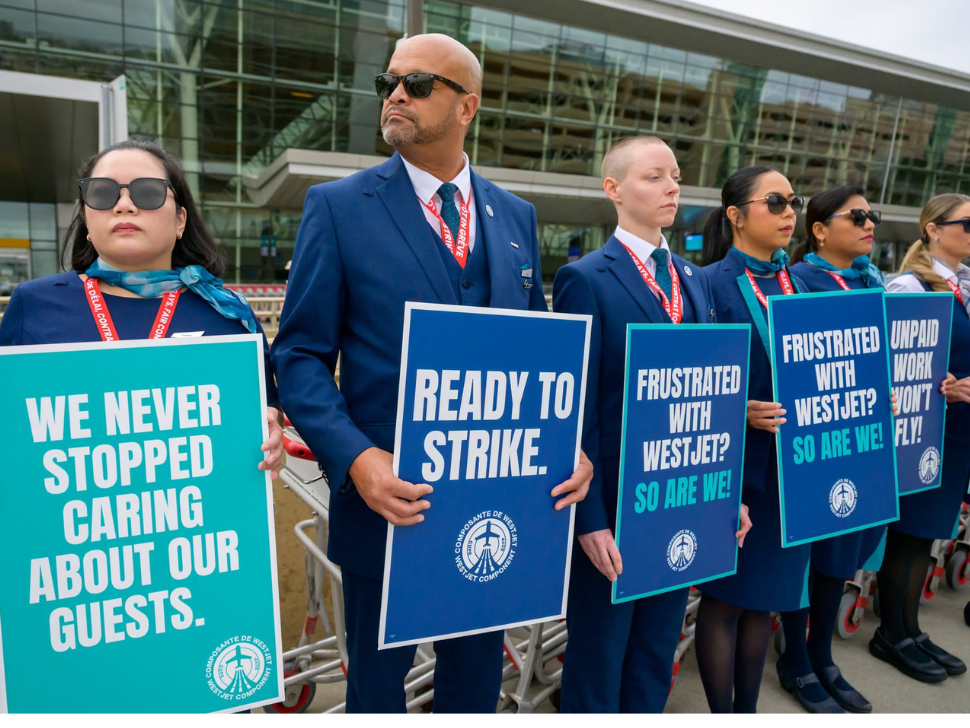
WestJet strike concerns have become a major issue for travellers, airline employees and employers watching labour relations in Canada.
Recently, CUPE, the union representing approximately 4,400 WestJet flight attendants, announced that 99.04% of vote members supported a strike mandate. Although a strike could legally begin as early as August 2, 2026, negotiations are still underway, and no strike has occurred.
For employers, the bigger lesson is not only whether WestJet reaches an agreement. It is what every organization can learn before a labour dispute reaches that stage.
Whether the organization operates in mining, construction, transportation, manufacturing, municipalities or another unionized industry, the same principle applies: employers that prepare early are usually better positioned to protect operations if job action begins.

A Strong WestJet Strike Vote Is an Operational Warning
A strike authorization vote does not automatically mean employees will walk off the job.
However, an overwhelming result like WestJet’s 99.4% strike mandate is a clear signal that concerns within the bargaining unit are significant.
Rather than waiting for formal strike notice, employers should review contingency plans, identify operational risks and confirm who will be responsible for key decisions if negotiations become more difficult.
The greatest opportunity to prepare is before a strike deadline, not after one.
Source: CUPE – WestJet cabin crew overwhelmingly vote yes to strike action
The WestJet Labour Dispute Involves More Than Wages
One of the central issues in the WestJet negotiations involves compensation for work performed before takeoff, including boarding passengers, conducting safety demonstrations and preparing the aircraft.
WestJet and CUPE disagree on how these duties are compensated. However, the broader lesson extends beyond aviation.
Many labour disputes begin with concerns employees believe management has not fully recognized. Those concerns may involve travel time, equipment preparation, shift handover, safety meetings, scheduling, fatigue or other work performed outside traditional paid hours.
Issues that may appear relatively small from a management perspective can become major bargaining priorities if employees believe they are unfair.
Organizations should look beyond wage increases and consider whether their compensation practices accurately reflect the work employees perform every day.
Sources: PAX – WestJet strike showdown: Here’s what the experts are predicting
Communication Should Begin Before the Deadline
During any labour dispute, communication quickly becomes just as important as negotiations.
Employees, customers, suppliers, contractors and the media may all want timely and consistent information. If the employer waits until strike notice is issued, messaging can become rushed, inconsistent or reactive.
Employers should identify who communicates with each group before the dispute escalates. Waiting until strike notice is issued often leads to inconsistent messaging, unnecessary confusion and increased uncertainty.
Effective communication is not about winning public opinion. It is about maintaining trust, reducing confusion and helping stakeholders understand how the organization is responding.
Source: Western Protection Alliance – What Pre Strike Planning Should Actually Include in Canada
Operational Planning Cannot Wait
By the time picket lines appear, many operational decisions should already be made.
Employers should review critical business functions, supplier dependencies, contractor requirements, access points, supervisor responsibilities and decision-making authority before job action begins.
For mining, construction, transportation, manufacturing and municipal employers, this planning may involve site access, shift changes, vehicle movement, contractor coordination and labour dispute security.
The answers will differ from one organization to another. However, every employer benefits from asking these questions before disruption begins.
Documentation Matters During Labour Disputes
One of the most overlooked aspects of labour dispute preparedness is documentation.
During periods of heightened tension, employers often focus on maintaining operations. However, they may also need accurate records.
Documenting incidents, operational disruptions, access issues and significant events can provide valuable information for legal counsel, insurance providers and internal decision-making.
Having objective documentation also helps organizations understand what occurred and improve future contingency planning.
Labour Disputes Affect More Than One Organization
Although the current negotiations involve an airline, the potential disruption could extend beyond WestJet itself.
Passengers, airports, suppliers, hotels, transportation providers and businesses that rely on employee travel may all experience disruption if job action occurs.
The same pattern exists in many industries.
A labour dispute at one organization can affect contractors, project schedules, supply chains, customers and external partners across an entire sector.
Employers should therefore consider not only their own workforce, but also the outside organizations that support their operations.
WestJet Strike Lessons for Employer Preparedness
The potential WestJet strike is a reminder for every unionized employer.
Labour disputes do not become operational challenges overnight. They develop over time through bargaining, communication, planning and preparation.
Organizations that wait until formal strike notice is issued often find themselves reacting to events rather than managing them.
Those that prepare early generally have more options, clearer communication and stronger operational resilience.
At Western Protection Alliance, we help employers prepare for labour disputes before they become operational disruptions. Our work includes contingency planning, labour dispute security, secure site access, supervisor coordination, picket line access and objective incident documentation.
The best outcome is always a negotiated agreement. However, responsible employers understand that preparation should begin long before the first picket line appears.
Sources
- CUPE – WestJet cabin crew overwhelmingly vote yes to strike action
https://cupe.ca/news/westjet-cabin-crew-overwhelmingly-vote-yes-strike-action - PAX – WestJet strike showdown: Here’s what the experts are predicting https://www.paxnews.com/news/airline/westjet-strike-showdown-heres-what-experts-are-predicting?
- Western Protection Alliance – Labour Dispute Management Services https://www.westernalliance.ca/labour-dispute-management-services/
- Western Protection Alliance – What Pre Strike Planning Should Actually Include in Canada https://youtu.be/Ol6obbiEvvM?si=G00LfSlsb4B4f-N7
- Western Protection Alliance – Why Evidence Gathering Can Make or Break a Labour Dispute Response In Canada https://youtu.be/OZMICuSwYB8?si=ya9vyhQ9MrSBUVv8