
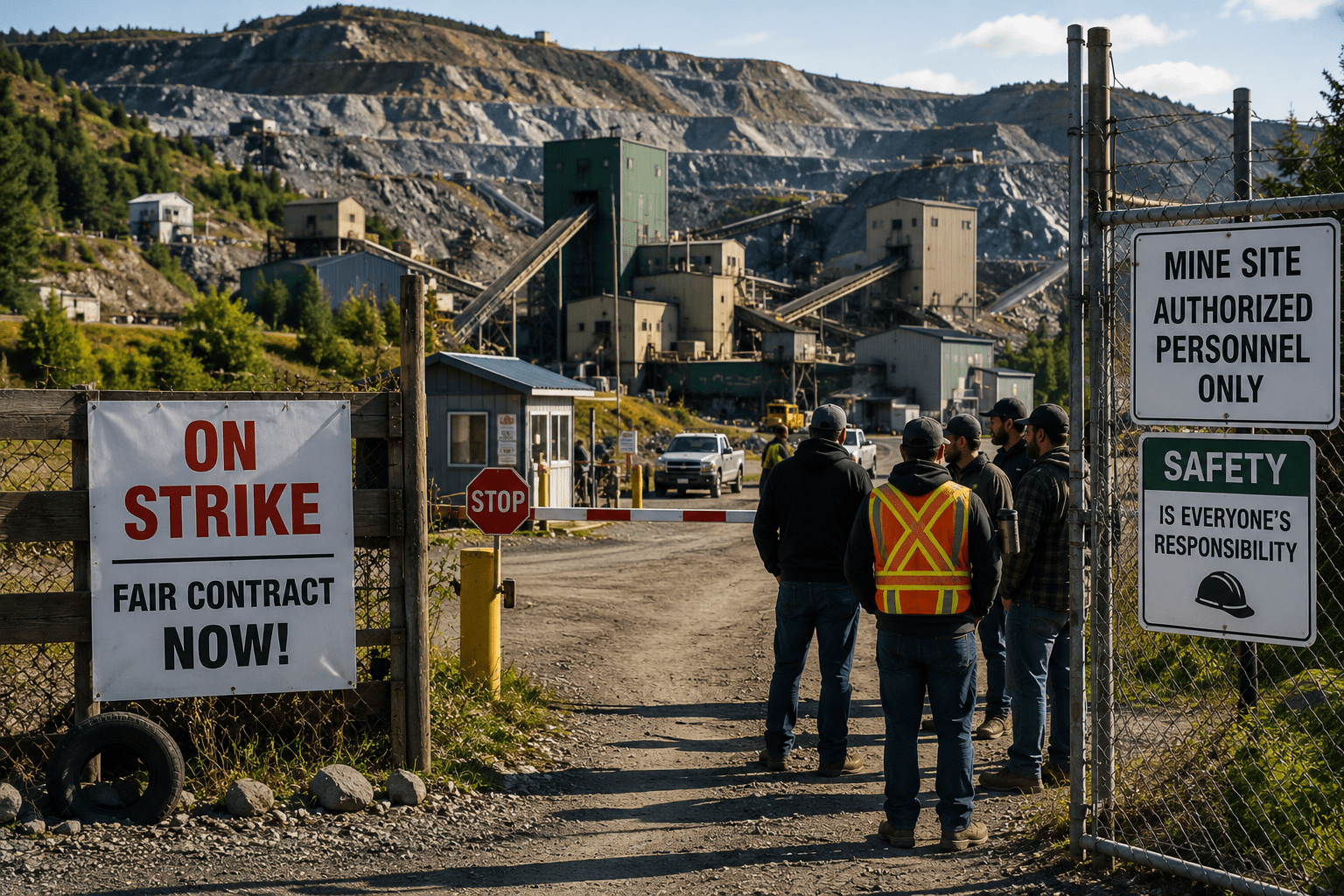
Mining strikes are different from most labour disputes because mines are often remote, highly regulated, supply-chain dependent and closely connected to the communities around them.
When a mine faces a strike, lockout or prolonged labour disruption, the impact is rarely limited to the picket line. It can affect production, equipment safety, transportation, contractors, local businesses, management security, replacement worker logistics and the broader supply chain.
For mine managers, the key issue is not only whether a strike may happen. The larger question is whether the company has planned early enough to manage the risk when pressure arrives.
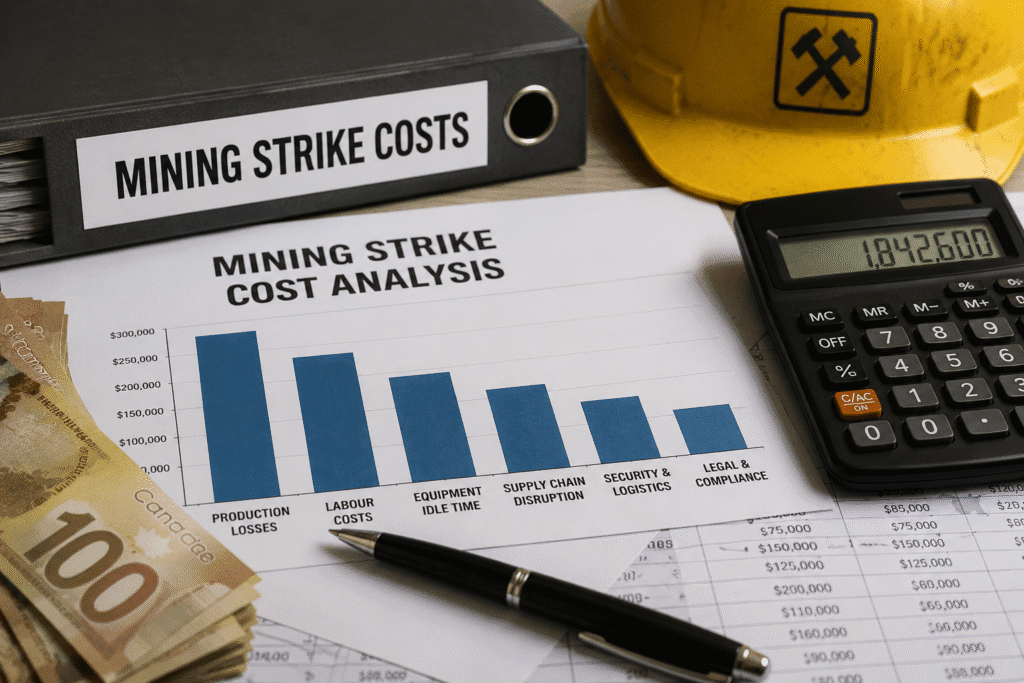
Remote Mine Sites Are Harder to Protect
Many mining operations are located far from major urban centres. That distance creates challenges during a labour dispute because personnel, supplies, security teams and replacement workers may all take longer to move into position.
Remote sites can also feel isolated once a dispute begins. A single access road, camp entrance, airstrip, rail connection or supply route can become a major pressure point. If the company waits until a strike or lockout is active, it may struggle to bring in labour dispute security, transportation support, evidence collection teams or executive protection resources quickly enough.
Mine strike planning should account for geography before the dispute begins. The plan should identify where personnel will stage, how security will travel, how supplies will move and how the company will maintain access if the site comes under pressure.
Source: Natural Resources Canada – Mining and mineral resource development in Canada
One-Industry Towns Create More Pressure
Many mines operate near communities where mining is one of the main sources of employment and local business activity.
When a labour dispute begins in that environment, the emotional impact can spread beyond the mine gate. Employees, families, contractors, suppliers, local businesses and community members may all feel the pressure. Even people who do not work at the mine may have a personal or financial connection to the outcome.
This can make mine strikes more emotional than disputes in larger urban centres. Outside security personnel, replacement workers and management representatives may also stand out more in a smaller community. Mine managers may need to consider not only picket line access, but also management safety, housing, transportation and community-facing risk.
Why Mining Strikes Can Last Longer
Mining strikes can become prolonged because mine operations rely on specialized skills and complex systems.
Many sites depend on heavy-duty mechanics, millwrights, equipment operators, maintenance teams, process plant workers and technical personnel. These roles are not always easy to replace, especially in remote locations.
Bill C-58 has added another layer of complexity for federally regulated employers. The legislation restricts the use of replacement workers during legal strikes and lockouts in federally regulated workplaces, subject to limited exceptions. For mining operations connected to federal jurisdiction, transportation, rail, ports or uranium-related operations, this issue should be reviewed carefully before a dispute begins.
Source: Government of Canada – Replacement Workers Legislation Now in Force
Mining Strikes Face More Scrutiny
Mining is already subject to significant safety, environmental and regulatory obligations. During a labour dispute, those obligations do not disappear.
A mine may still need to maintain safety systems, monitor equipment, manage dewatering, protect environmental controls, secure hazardous areas and maintain essential site functions. Some equipment may require orderly shutdowns. Other systems may need regular inspection, even if production slows or stops.
This means a mine strike can attract attention from regulators, legal counsel, police, media, local government, Indigenous communities and the public. The company should have a plan that protects safety, documents decisions and shows that management understood the risks before the disruption began.
Source: Government of British Columbia – Health, Safety and Reclamation Code for Mines in British Columbia
How Mining Strikes Affect the Supply Chain
A mine does not operate in isolation.
It relies on fuel, contractors, replacement parts, camp supplies, transportation, rail, port access, maintenance providers and customer commitments. When a mine strike affects production or product movement, the disruption can move through the supply chain.
Rail and port disruption can also affect mining operations even when the labour dispute is not at the mine site itself. In 2024, Reuters reported that a Canadian rail stoppage could cost the economy more than C$341 million per day. It also reported that a rail halt could affect North American supply chains because Canadian and U.S. freight movement are closely connected.
Source: Reuters – Canada rail stoppage could cost C$341 million per day, Moody’s says
Source: Reuters – Why the Canadian freight rail halt will roil North American supply chains
Pre-Strike Planning Should Start Early
Mine managers should not wait until a strike notice appears before building a labour dispute plan.
Pre-strike planning should begin before bargaining reaches a crisis point. The company should understand its access points, vulnerable routes, critical suppliers, replacement worker options, management security needs, evidence collection plan, police communication process and legal strategy.
The plan should also identify what the strike security provider needs to bring to the table. That may include trained personnel, site supervisors, evidence collection capability, mobile patrols, executive protection, transportation support and experience working in remote mining environments.
A late plan is usually an expensive plan. Once the dispute begins, every missing detail becomes harder to fix.
Evidence Collection and Executive Protection Matter
Evidence collection is critical during a mine strike.
The company may need to document blocked access, vehicle delays, intimidation, property damage, unsafe conduct, secondary picketing, off-site incidents or interference with lawful movement. Evidence may include video, photographs, incident reports, access logs, vehicle delay records, witness notes and communication records.
In some mining disputes, the company may also need executive protection or mobile security support away from the main gate. Smaller communities, local emotion and long-running disputes can create risk around management residences, hotels, transportation routes or off-site staging areas.
The goal is not to escalate the situation. The goal is to preserve an accurate record and help protect people, property and operational continuity.
Replacement Worker Logistics Require Careful Planning
Replacement workers can become a major source of tension during a mine strike.
If replacement workers are permitted and used, the company must plan their transportation, housing, security and daily movement carefully. They should not be left to cross a picket line alone in personal vehicles without a plan.
In some situations, housing replacement workers on site may reduce repeated crossings and lower exposure. If the company houses workers off site, it should consider location, transportation routes, hotel security, privacy and worker safety.
These plans should be reviewed with labour counsel, especially where Bill C-58 or provincial labour laws may affect what is permitted.
Mining Strikes Require a Different Response
Mining strikes are more complex than many other labour disputes because they combine remote logistics, community pressure, regulatory obligations, supply chain exposure and specialized labour needs.
A strong response should include early planning, professional strike security, evidence collection, police communication, executive protection where needed, replacement worker logistics and a clear operational continuity plan.
At Western Protection Alliance, labour dispute and mine site security are not just about placing personnel at a gate. They are about helping operators protect access, safety, documentation, management confidence and continuity during high-risk periods.
If your organization operates a remote mine or mining project, the best time to plan for a labour dispute is before the dispute begins. Once the picket line forms, every delay, missing report, staffing gap or unclear instruction can make the response harder than it needs to be.
Sources
- Natural Resources Canada – Mining and mineral resource development in Canada
https://natural-resources.canada.ca/minerals-mining/canadian-mineral-exploration - Government of Canada – Replacement Workers Legislation Now in Force
https://www.canada.ca/en/employment-social-development/news/2025/06/protecting-canadian-labour-replacement-workers-legislation-now-in-force.html - Government of British Columbia – Health, Safety and Reclamation Code for Mines in British Columbia
https://www2.gov.bc.ca/gov/content/industry/mineral-exploration-mining/health-safety/health-safety-and-reclamation-code-for-mines-in-british-columbia - Reuters – Canada rail stoppage could cost C$341 million per day, Moody’s says
https://www.reuters.com/business/canada-rail-stoppage-could-cost-c341-mln-per-day-moodys-says-2024-08-21/ - Reuters – Why the Canadian freight rail halt will roil North American supply chains
https://www.reuters.com/world/americas/why-canadian-freight-rail-halt-would-roil-north-american-supply-chains-2024-08-21/ - Western Protection Alliance – Why Mining Strikes Cost Companies Millions in Canada https://youtu.be/aN_Ujik2PMY?si=n-MT7J86ZOtK_ja6